
New Delhi [India], June 10: In a major push toward rewriting India’s urban transport landscape, top policy experts, administrative leaders, and civil society advocates have called for a radical departure from “car-centric” development. The paradigm shift comes amid reports that the Union Cabinet is poised to clear a landmark scheme to phase out commercial BS-IV trucks and buses. Simultaneously, state governments are aggressively reviving local public transit networks—highlighted by Madhya Pradesh’s decision to re-launch its state-wide public bus service after a 21-year hiatus.
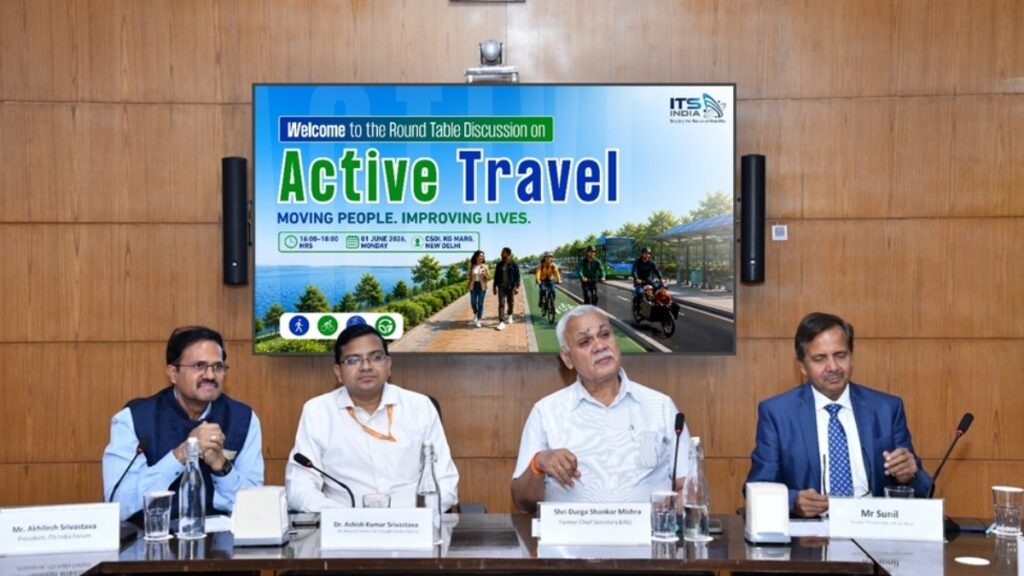
To bridge these massive national policy shifts with ground realities, the Intelligent Transportation Systems (ITS) India Forum hosted a high-level Round Table Discussion on Active Travel in India. The conclave underscored a critical national consensus: the future of Indian cities lies in shifting from “moving vehicles” to “moving people safely.”
The Multi-Pronged National Push for Transit Modernization
India’s current transport ecosystem faces a twin crisis of severe air pollution and escalating road fatalities. Policy interventions at the highest levels are mobilizing to counter this. The Union Government’s proposed scheme to phase out older BS-IV commercial trucks and buses targets vehicular emissions directly, which experts state accounts for up to 60% of urban air pollution.
Complementing the clean fleet transition is the revival of public transport infrastructure on the state level. The Madhya Pradesh government’s historic re-launch of its state-wide public bus service ends a 21-year gap that left rural and intercity commuters vulnerable to unregulated private operators. Analysts note that introducing structured state fleet networks is essential to curbing traffic congestion and laying down a multimodal framework where public transit and active travel—such as walking and cycling—coexist.
Flipping the Priority Pyramid: Insights from the Conclave
Presiding as the Chairperson of the Round Table discussion, Shri Durga Shankar Mishra, IAS (Retd.), Member of the High-Level Committee on Demographic Change and former Chief Secretary to the Government of Uttar Pradesh, called for a complete overhaul of urban planning paradigms.
“The National Urban Transport Policy established in 2006 explicitly stated that our focus must be on moving people, not moving vehicles,” Shri Mishra noted. “Unfortunately, moving vehicles became the priority. We widened roads, built flyovers, and added underpasses, yet congestion has only worsened. The best global cities are actively cutting down car access in high-footfall areas. It is high time our urban redevelopments emphasize ‘last mile connectivity’ and prioritize walk able designs.”
Addressing the economic and structural metrics used by municipal bodies, Dr. Ashish Kumar Srivastava, IAS, Regional Director of the Staff Selection Commission (Central Region, Prayagraj), presented data revealing a massive “latent demand” for walking and cycling in Indian cities.
“Our research shows that 59% of all daily urban trips in India are less than 5 kilometers, and 28% are under 2 kilometers,” Dr. Srivastava revealed. “Yet, over 57% of these short trips are performed via motorized transport. People want to walk, but our city infrastructure denies them the opportunity. We must reform our cost-benefit analysis models for government projects to accurately value the ‘intangible benefits’ of active mobility—such as public health improvements and social inclusion—rather than just tracking vehicular travel time.”
Safety, Denial, and Grassroots Action
A glaring theme of the discussion was the structural danger currently posed to vulnerable road users. Ms. Sarika Panda Bhatt, Co-Founder of the Raahgiri Foundation, highlighted the severe lack of basic safety design in rapidly growing corporate hubs like Gurugram.
“We are cutting down trees and widening roads for cars, creating urban heat islands and chronic waterlogging, while basic 1.8-meter footpaths are treated as an afterthought,” Ms. Bhatt stated. She criticized the bureaucratic inertia regarding the public health impact of emissions: “We are in deep denial about air pollution. Our country loses 3.5% of its GDP to road traffic crashes, yet our entire transportation budget is just 1.79% of our GDP—and 80% of that goes strictly toward constructing more roads for cars. We must reverse this mobility pyramid.”
The discussion also highlighted successful micro-interventions carried out by the Raahgiri Foundation, including transforming chaotic school zones into high-visibility, child-friendly spaces with proper crosswalks and slowing traffic around high-fatality black spots.
Adding to the commuter perspective, Dr. Nakul Parashar, Former Director of Vigyan Prasar (DST, Government of India), emphasized that user experience must dictate multi-modal design. He observed that while awareness is rising via social media, infrastructural gaps—such as non-functional escalators at transit hubs or the lack of safe late-night public transport to airports—force citizens back into private cars.
Technological Integration as the Catalyst
The forum concluded with a forward-looking consensus on leveraging indigenous technology to safeguard active travelers. Mr. Akhilesh Srivastava, President of the ITS India Forum, detailed how digital age solutions can reduce the 35% fatality rate suffered by pedestrians. He advocated for Vehicle-to-Pedestrian (V2P) technology, which utilizes mobile networks and alerts to bridge safety gaps.
Echoing this, Mr. Sunil, President of the Institution of Electronics and Telecommunication Engineers (IETE), highlighted breakthrough home-grown technology, such as Direct-to-Mobile (D2M) broadcasting developed by IIT Kanpur. This technology allows seamless road and emergency connectivity without requiring active cellular data or SIM cards, ensuring even the most vulnerable commuters remain connected and safe.
A Unified Road to 2047
With India’s urban population projected to cross the 50% threshold in the coming decades, the Round Table served as a critical reminder that incoming urban expansions must follow strict human-centric guidelines. By combining macro-level fleet upgrades like the BS-IV phase-out and state bus revivals with micro-level walk-able urban design, India can achieve a transport ecosystem that is both highly efficient and in sync with nature.
Dr. Shiv Kumar, Director General of the ITS India Forum, summed up the consensus of the afternoon: India’s mobility transition — from reviving buses to scrapping older fleets — must be built around people who walk and cycle, not only those who drive.
If you object to the content of this press release, please notify us at [email protected]. We will respond and rectify the situation within 24 hours.